Related arts
Ch'i kung (qigong): breathing, posture and practising sensibly
Most t'ai chi classes include a few minutes of quiet standing, slow repeated movements and attention to the breath. These exercises belong to a much larger family of Chinese practices called qigong, or ch'i kung. Done sensibly, they are among the gentlest things in the whole curriculum.
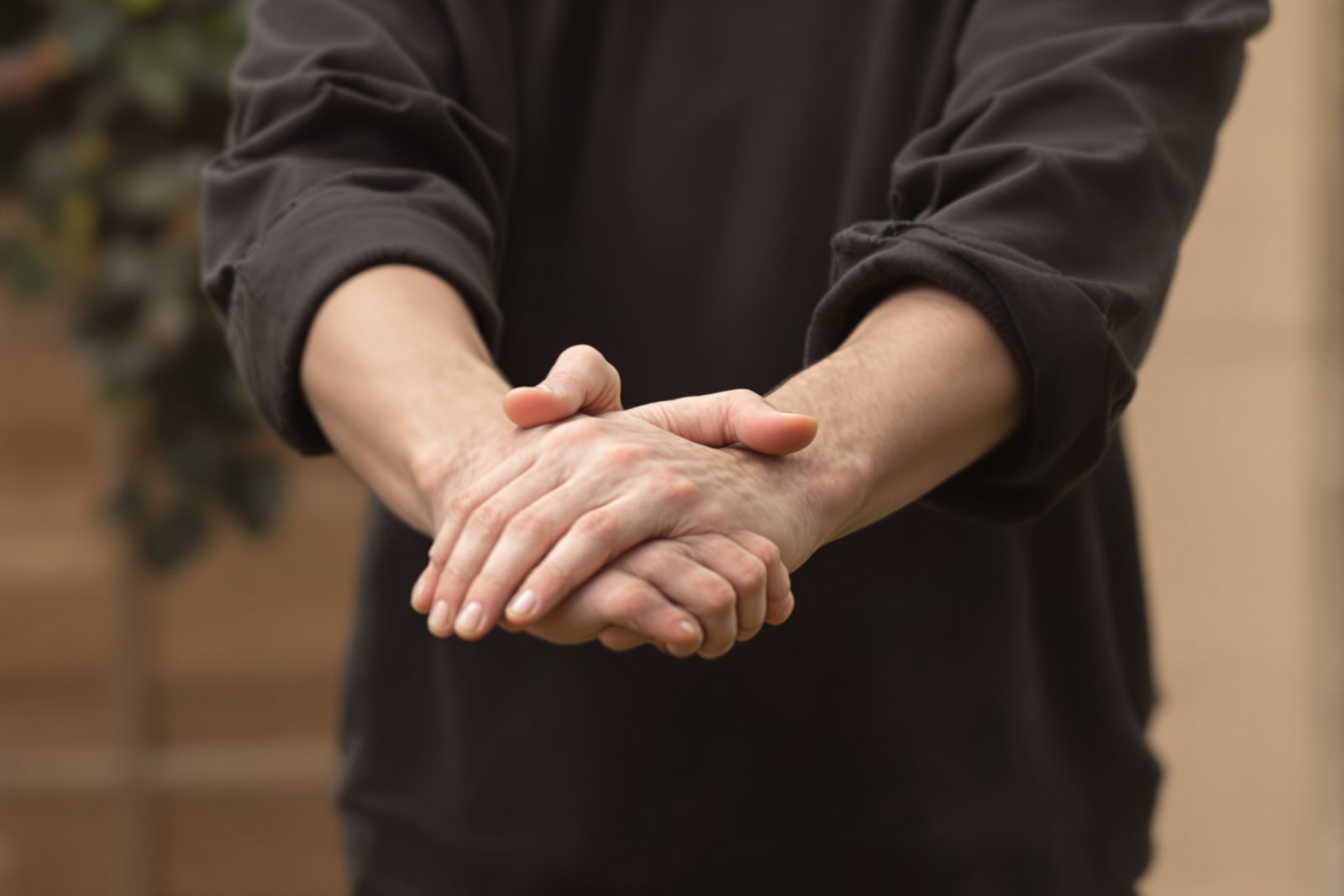
What qigong is
Wikipedia's article on qigong describes it as a system of coordinated body posture and movement, breathing and meditation, with roots in Chinese medicine, philosophy and martial arts, practised in China and around the world for recreation, exercise, relaxation, meditation and martial training among other reasons. It explains that the word joins qi, which primarily means air, gas or breath and is often translated as a vital energy, with gong, meaning cultivation or work. The article also notes that the modern term was promoted in the middle of the twentieth century to group a broad range of self-cultivation exercises under one name.
The National Center for Complementary and Integrative Health describes qigong as involving the regulation of the mind, the breath and the body's movement and posture. It distinguishes dynamic techniques, which focus on movements of the whole body or limbs, from meditative ones, practised in a posture that can be held for a time with almost no movement. It also describes tai chi, when performed for health, as one of the hundreds of forms of qigong exercise developed in China.
Standing practice
Standing is the simplest and often the most demanding qigong exercise. You stand with the feet about shoulder-width apart, the knees soft, the spine upright and the arms held in a relaxed round shape, as if loosely embracing a large ball. Nothing moves except the breath. Attention goes to finding and releasing tension: the jaw, the shoulders, the lower back, the knees.
Beginners should start with a few minutes and a high posture. Standing longer or lower is not better if it produces strain.
Moving practice
Moving qigong uses a small number of simple, repeated movements: raising and lowering the arms with the breath, turning the waist, shifting the weight, stretching gently in several directions. The repetition lets attention settle on the quality of the movement—smooth, relaxed, unhurried—rather than on remembering a sequence. Many t'ai chi teachers use such exercises as a warm-up, or to isolate a principle of the form.
Qigong and t'ai chi
The two share principles: upright posture, relaxation, whole-body movement and natural breathing. The difference is mostly one of scope. A t'ai chi form is a long, varied sequence with martial meaning; qigong exercises are usually short and repeated, aimed at posture, breath and attention. Practising some qigong often helps the form, because it gives time to feel details that pass quickly in the sequence.
Practising without forcing the breath
- Breathe through the nose if comfortable, slowly and quietly.
- Let the breath follow the movement; do not stretch the movement to fit a forced breath.
- Never hold your breath during an exercise.
- If you feel light-headed, return to normal breathing and sit down.
- Complicated breathing methods are best learned only from an experienced teacher, if at all.
The NCCIH notes that qigong breathing is slow, long and deep. The key is that it becomes that way through relaxation and practice, not through effort.
Treat exaggerated claims with caution
Qigong has attracted extraordinary claims: that it can take the place of medical treatment for serious illness, that practitioners can project energy into other people or knock them over without touching them, or that particular methods unlock secret powers. Wikipedia's article on qigong notes that qi is often described as a supposed energy circulating through the body, and the NCCIH's own page describes research on qigong as limited in several areas and conflicting in some. Its advice is plain: do not use qigong to put off seeing a health care provider about a medical problem.
Traditional teachers have long warned, too, that forcing breathing or concentration exercises can leave people feeling unsettled, dizzy or anxious. The sensible response is simple: keep practice gentle, stop if something feels wrong, and learn from a teacher who can explain what they teach in plain language. Be wary of anyone who sells qigong as a medical treatment or asks you to abandon one.
Where to go next
Qigong sits naturally beside the other practices in this guide. For the slow solo form, see New to t'ai chi?; for the wider research on tai chi, see what research has looked at; and for qigong within a broader training programme, see weapons and specialty training.