Weapons
The sabre: the dao in t'ai chi
If the straight sword is the scholar's weapon, the sabre is the soldier's. Heavier, broader and single-edged, it asks for committed, sweeping movement, and it brings out a side of t'ai chi that the slow hand form can hide.
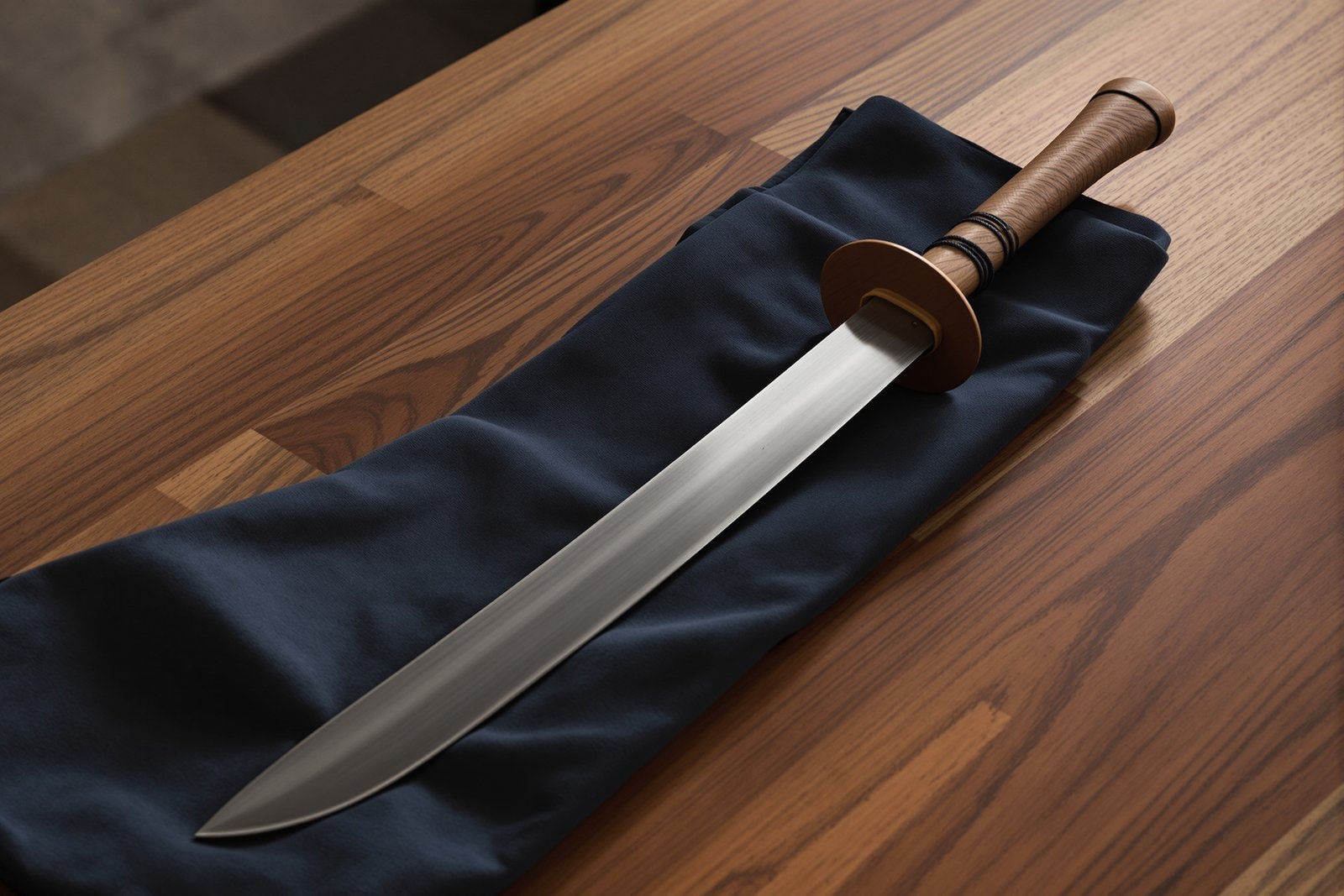
What the dao is
Wikipedia's article on the dao describes single-edged Chinese swords used mainly for slashing and chopping, straight or curved, with the most common form known in English as the Chinese sabre and wider-bladed versions sometimes called broadswords. The same article notes that in China the dao is counted among the four traditional weapons, with the staff, the spear and the straight sword, and that within that group it is called "the General of Weapons".
That nickname pairs neatly with the straight sword's title. Wikipedia's article on the jian records that the straight sword is often revered as "the Gentleman of Weapons". General and gentleman: the two blades are often taught as a contrasting pair.
Blade and fittings
According to the dao article, most single-handed dao from the Ming period onward share a moderately curved, single-edged blade, often with a few inches of the back edge also sharpened so that the curve still allows a thrust. Hilts are sometimes angled against the curve of the blade, the handle is usually wrapped with cord over wood, and guards are typically disc-shaped and often cupped. Modern performance sabres often carry a tassel or scarf at the pommel.
Jian and dao compared
- Edges. The jian has two edges and a point designed for thrusting; the dao has one main edge and a heavier spine.
- Shape. The jian is straight and slender; the dao is curved and broadens towards the tip.
- Weight and balance. The dao generally feels heavier towards the blade, which suits cutting through an arc.
- Movement. Jian techniques are small, exact and quick, guided by the wrist and fingers; dao techniques are large, sweeping and powered by turning the whole body.
- Character. Teachers often describe the jian as elegant and restrained, and the dao as bold and direct.
The character of sabre movement
Sabre forms are full of wide horizontal cuts, rising and falling chops, and spinning wraps in which the blade circles close around the head and shoulders to protect the body before the next cut. The free hand often rests against the back of the blade or the wrist, adding support and guiding the direction of the cut. The footwork tends to be vigorous, with turning steps and sudden changes of direction.
For a t'ai chi practitioner, the challenge is to keep the art's principles inside all that energy. The cut should come from the turning of the waist and the push of the legs, not from the arm alone. The body should stay upright and relaxed even as the blade moves quickly. Done well, sabre practice feels like the hand form released at a different speed.
The dao in Yang-style training
Sabre forms are a standard part of many Yang-style curricula. Wikipedia's article on Yang-style tai chi is a useful reminder of how they fit: it describes Yang Chengfu removing vigorous releases of power, jumping and stamping from the solo hand form, while retaining them in the weapons forms, which it lists as sword, sabre, staff and spear. For many Yang-style students, the sabre is where they first meet the more forceful side of their own tradition.
Most schools teach the sabre after the straight sword, or alongside it, and only once the hand form is secure. Beginners often start with a wooden sabre, which is safer and lighter, and move to a blunt metal training blade later.
Training tips
- Start slowly. Learn the path of each cut at walking pace before adding speed.
- Keep the wraps wide at first. The protective circles around the head come closer with practice, not on day one.
- Mind the wrist. A heavy blade strains a stiff wrist. Let the body carry the weight.
- Watch the knees. Turning steps under momentum can twist a planted knee; lift or pivot the foot as your teacher shows you, and read knees, joints and a lifetime of practice.
- Clear the space. Sweeping cuts need far more room than sword thrusts.
For the straight sword that the sabre is so often compared with, read the sword of t'ai chi. The staff, spear, walking stick and fan are covered in weapons and specialty training.