Practice
San shou: the two-person t'ai chi form
The solo form teaches you how to move. Sooner or later, a student wants to know what the movements are for. San shou, a long set performed by two partners, answers that question in slow motion.
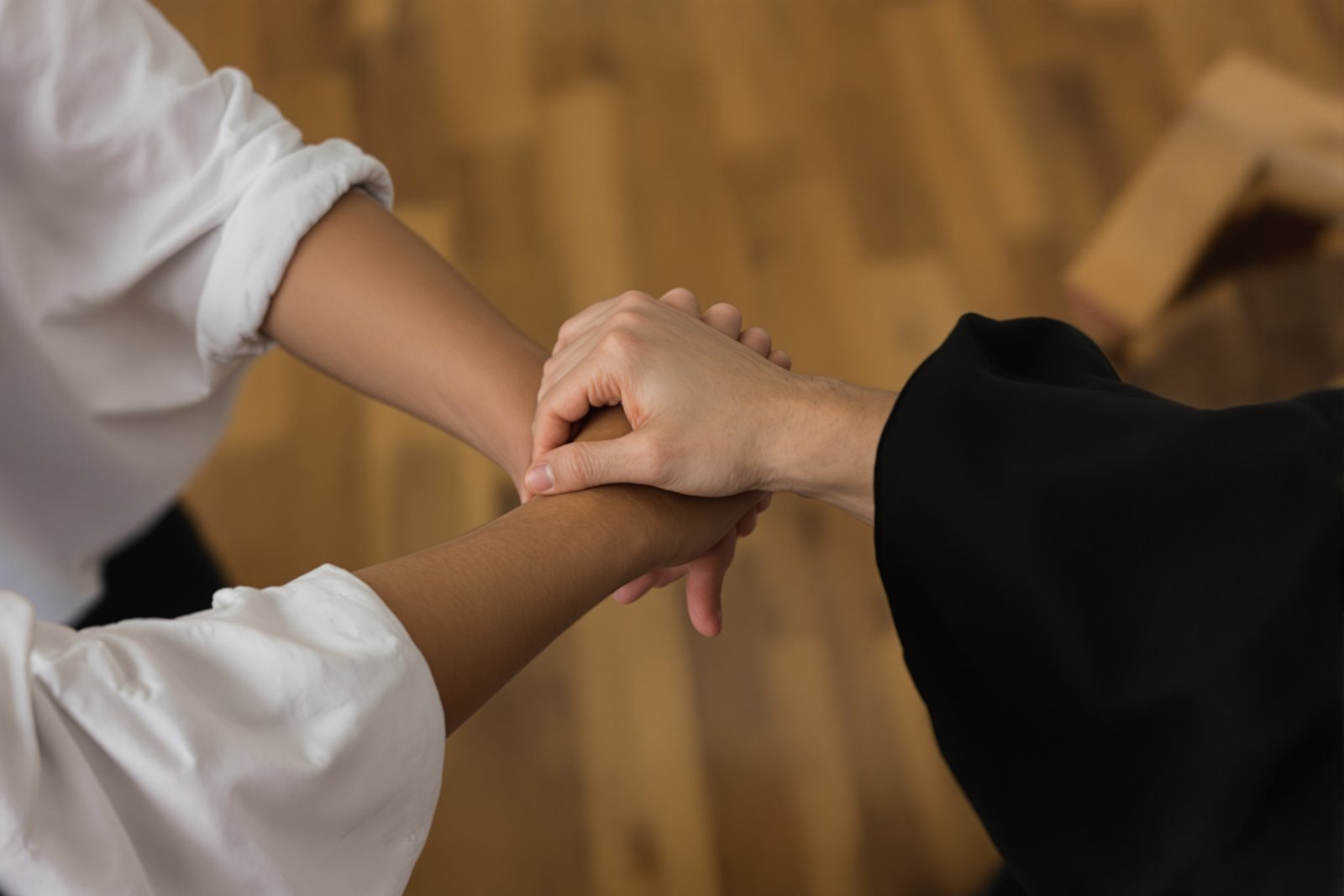
What san shou is
San shou is a choreographed partner form. Two people, usually designated by the side they begin on, perform a fixed sequence in which one attacks and the other responds, then the roles change, back and forth, until the set is complete. Each movement is drawn from the solo form: a posture that looked abstract when practised alone suddenly has a partner's wrist, elbow or shoulder at the other end of it.
The name can mean different things in different contexts. In some martial circles it refers to free sparring, but in the traditional Yang curriculum it usually means this two-person set. Tchoung Ta-tchen's book, according to Wikipedia's article on him, featured san shou alongside his short form and pushing hands, which gives a good sense of where the set sits: after the solo form, beside partner drills, as part of a complete system.
A bridge between form and pushing hands
Most students meet two kinds of partner practice. Pushing hands is open-ended: partners keep contact and feel for each other's balance, with no fixed sequence. San shou is the opposite: every step is known in advance. The two complement each other.
- The solo form gives you the movements.
- San shou shows you, in a controlled setting, how those movements meet an incoming force, where the distance should be and how the feet must move.
- Pushing hands then asks you to apply the same sensitivity without knowing what is coming.
Wikipedia's article on pushing hands names three principles cultivated by partner training: rooting, or a stable stance; yielding, or flowing with incoming force without losing balance; and the release of power. San shou gives all three a script, so that they can be studied slowly before they are tested freely.
Timing and distance
The real lessons of san shou are not the individual techniques but the space and time between the partners.
Distance
If you stand too far away, the attack cannot reach and the response is empty. Too close, and neither partner has room to move. Much of the early work is finding the distance at which an attack is genuine and a yield is necessary. That distance changes with each person's height and reach, which is one reason to practise with many partners.
Timing
In the solo form you set the pace. In san shou the pace is shared. A response that begins too early anticipates rather than answers; one that begins too late arrives after the force has already landed. Good partners learn to start moving at the moment the other commits, neither sooner nor later. This is the same "listening" that pushing hands trains, applied to a longer sequence.
Continuity
Like the solo form, san shou should flow without stops. Each response becomes the next attack. When the set is performed well, it looks less like a series of exchanges and more like a single conversation.
Learning the set
- Learn each side separately. Most teachers teach one role at a time, often with the teacher or a senior student as partner.
- Walk through it slowly. Early practice is almost static, with long pauses to check positions and angles.
- Learn the other side. Knowing both roles is what makes the set a whole, and it echoes the two-sided idea behind the symmetrical Yang form.
- Add smoothness, then gentle speed. Speed comes last, and only as far as both partners can control it.
Practising safely
- Agree on the pace and the level of contact before each round, and keep them.
- Strikes are placed, not delivered. Stop well short of the face and throat.
- Joint-locking movements are shown, never forced. Release at once if a partner taps or speaks.
- Clear the floor of obstacles, and leave room for the steps backward that many sequences include.
- Remove rings, watches and anything else that could scratch or catch.
- Practise with a partner of similar experience, or with a senior student who can control both sides.
San shou is also a good test of patience. It can take a long time to perform a long partner set smoothly, and many students say that the effort changes how they perform their solo form. To keep that practice balanced, read progressing in t'ai chi.