Practice
Pushing hands (tui shou)
The solo form can make anyone look relaxed. Pushing hands asks whether the relaxation survives contact with another person. It is where t'ai chi's principles are tested, gently and honestly, one push at a time.
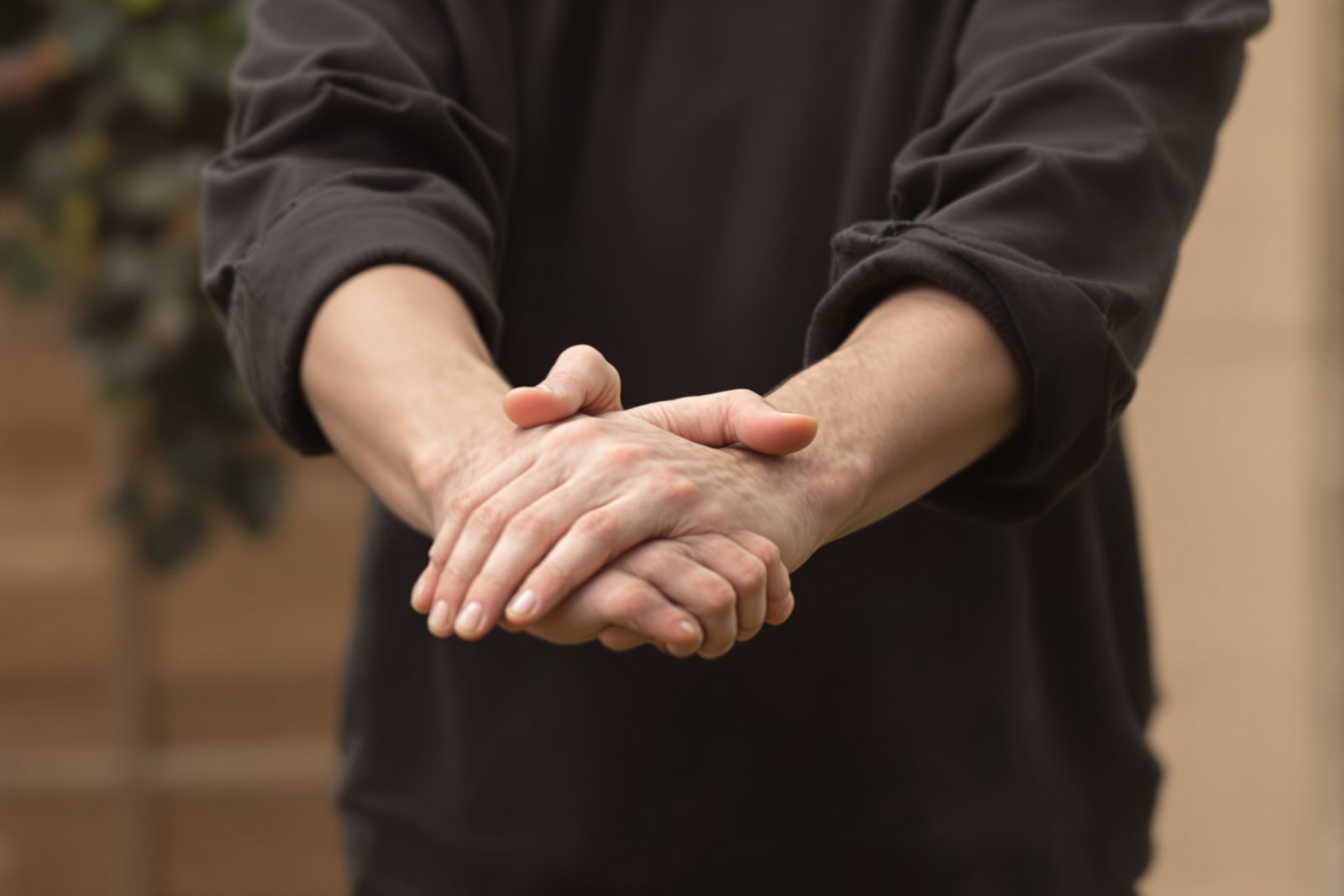
What pushing hands is
Wikipedia's article on pushing hands describes it as a two-person training routine practised in internal martial arts such as tai chi, baguazhang and xingyiquan, and also played as a competitive sport. According to the Chen family, the article says, it was created by Chen Wangting; other schools attribute it to the legendary Zhang Sanfeng. In tai chi, it is used to introduce students to a set of basic energies and footwork, and training generally involves contact but no strikes.
Partners stand facing each other with their forearms or wrists in light contact. One partner pushes, the other receives and neutralises the push, then returns it, and the exchange continues in a circle. The aim is not to win but to sense: to feel where the partner's force is going and what their balance is doing, and to keep your own balance while you do.
Three principles
The same article names three principles cultivated by pushing hands:
- Rooting: a stable stance and a well-trained sense of balance under pressure.
- Yielding: flowing with incoming force from any direction without giving up your own balance.
- Release of power: applying force to the partner while keeping rooting and yielding intact.
Most of the early years of practice are spent on the first two.
Fixed-step drills
Beginners usually start with the feet planted. In a single-hand drill, partners touch at one wrist and trace a slow horizontal circle together, one pushing forward as the other turns the waist and draws the push aside. Double-hand drills add the second arm and more complex patterns, eventually cycling through the classic energies often translated as ward off, roll back, press and push.
Fixed-step practice isolates the upper body and the waist. Because the feet cannot move, any stiffness in the shoulders or hips is immediately obvious: the push arrives, there is nowhere for it to go, and one partner or the other loses balance.
Moving-step drills
Once the fixed patterns are comfortable, partners begin to step: forward and back in a line, then in more complex patterns that move around the floor. Moving-step practice teaches footwork, timing and distance, and it links pushing hands with the choreographed san shou partner form. It is also more demanding on the knees, so keep stances at a comfortable height.
Listening and yielding
The key skill has a name: listening. Through the contact point, you try to feel your partner's intention before it becomes a push, and to follow it without resisting or losing contact. It sounds mysterious, but it is a trainable sensitivity, much like a dancer following a partner's lead.
Yielding follows listening. When a push arrives, you do not block it; you turn, sink and let it pass, keeping just enough contact to know where your partner is. The skill is to yield without collapsing: to give way with the arms and waist while the legs and root stay stable. The t'ai chi classics return to these ideas again and again.
Cooperative practice and competition
Most pushing hands in class is cooperative. Partners help each other learn, keep the pace slow and point out stiffness rather than exploit it. Competition is different: Wikipedia's overview of tai chi notes that competitors are judged on forms, pushing hands and free sparring. Competitive pushing hands, covered further on the page about gatherings and tournaments, rewards uprooting an opponent within rules that generally forbid strikes.
Both have value. Competition tests skill under pressure. But many teachers warn that too much competitive pushing too early turns the exercise into wrestling, and the sensitivity it is meant to develop never forms.
Practising safely and courteously
- Agree on the pace before starting, especially with a new partner.
- Keep pushes to the torso, never to the face, throat or knees.
- Do not grab or yank in cooperative practice.
- Stop when asked, and ask to stop whenever you need to.
- Protect the knees: move the whole body rather than twisting on a planted foot.
- Thank your partner. Every good partner is a teacher.
Pushing hands is one of the most enjoyable parts of t'ai chi once the first awkwardness passes. It also changes the solo form, because every posture starts to feel like a response to someone who is not there.