Weapons
The sword of t'ai chi: the jian
Of all the weapons in t'ai chi training, the straight sword is the one students most look forward to and most often underestimate. It is light, quick and unforgiving: a blade that rewards precision and exposes every lapse of balance.
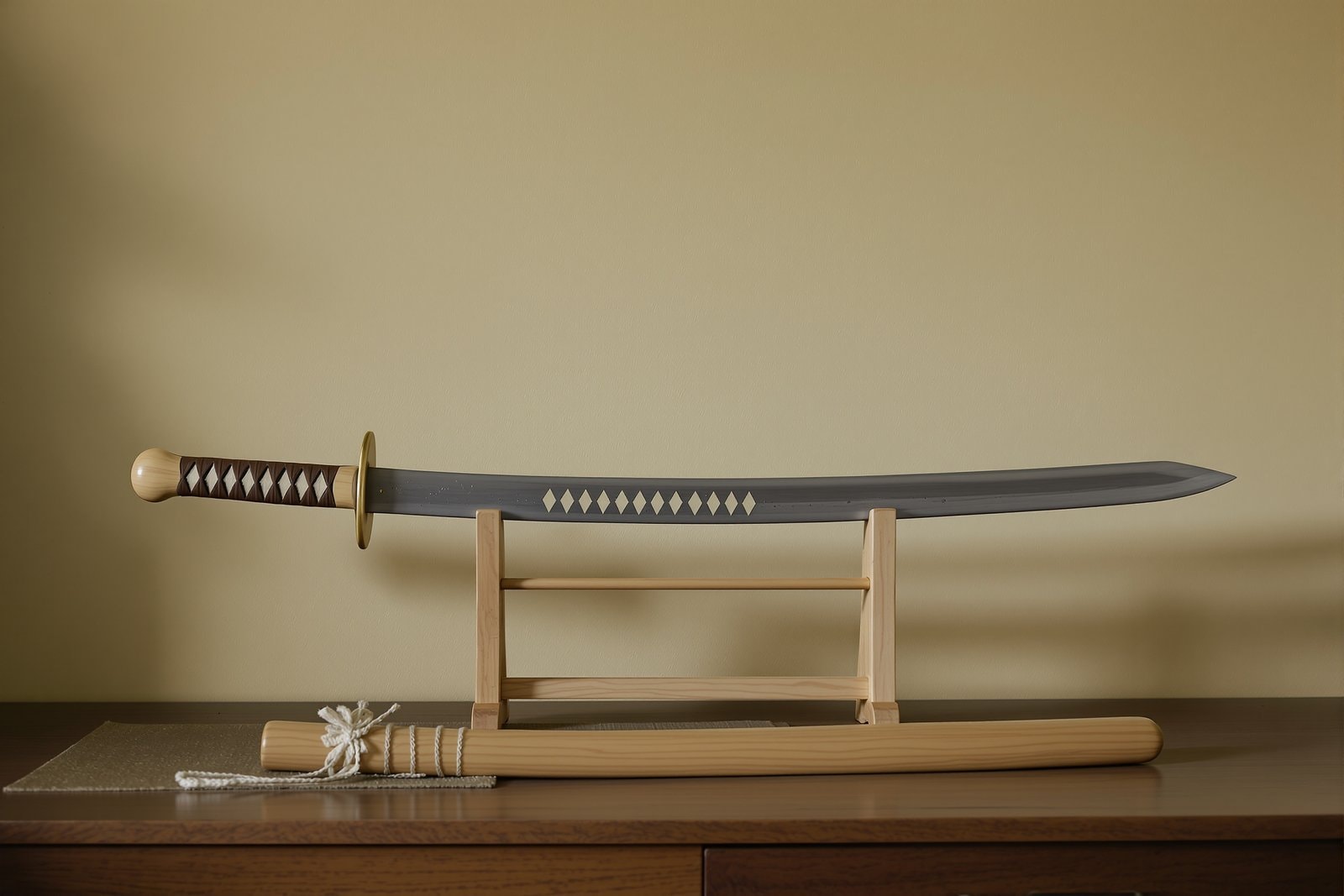
A double-edged, straight blade
The Chinese word jian covers every straight, double-edged sword. Wikipedia's article on the jian traces the weapon back to early bronze swords that were later replaced by steel ones, and notes that in Chinese culture it is often revered as "the Gentleman of Weapons", counted among the four foremost weapons together with the staff, the spear and the single-edged sabre. As a battlefield weapon it gave way to cheaper and more practical arms, but it kept its place as a personal weapon and as a mark of status and learning.
That reputation matters for how the sword is practised. The jian is not swung like a chopper. It is guided, with small, exact movements of the wrist and body, so that the edge or tip arrives where it is meant to without wasted force. Students often say that the sabre shows strength and the sword shows refinement.
Knowing the parts
Teachers use the names of the sword's parts constantly, so it helps to learn them early. The same Wikipedia article describes a blade traditionally divided into three working sections:
- The tip, used for stabbing, slashing and quick, light cuts.
- The middle edge, used for cleaving and drawing cuts and for deflecting.
- The root, the section nearest the guard, used mainly in defence.
Beyond the blade come the guard, which protects the hand; the handle; and the pommel, which the article describes as helping balance the sword, keeping the handle from sliding through a loosened grip, and serving in some techniques for striking or trapping. Many practice swords also carry a tassel at the pommel. It is decorative, but it also shows a teacher at a glance whether a movement was smooth or jerky.
How the sword extends the hand form
A t'ai chi sword form is not a separate art bolted onto the empty-hand form. It uses the same stances, the same weight shifts, the same turning of the waist and the same connection from the feet through the legs and torso to the hand. The only difference is that the hand now holds something that projects the movement a good distance further out. Any break in the chain shows up at the tip of the blade, magnified.
That is why sword training usually begins only after the solo form is secure, and why many teachers say it improves the hand form in return. When the arm tries to do the work alone, the sword wobbles; when the body moves as one, it settles into a clean line. The free hand has its own role too, usually held in a "sword finger" shape that balances the body and points the attention. Wikipedia's jian article notes that many Chinese martial arts, tai chi among them, still train extensively with the sword, and that today the tai chi sword forms are usually practised for exercise much as tai chi itself is.
Starting with a wooden sword
Most students begin with a wooden practice sword, and there are good reasons to stay with one for a long time:
- It is safe to practise near other people, in a park or in a crowded hall.
- Its weight and balance are close enough to a light metal sword to teach the movements.
- Mistakes cost a bruise, not a cut.
- It removes the temptation to perform, which keeps attention on the body.
Metal swords used in modern t'ai chi are generally flexible, blunt training or performance blades, not weapons of war. Even so, a metal blade deserves respect. Choose one of a length and weight your teacher recommends; a sword that is too heavy distorts every posture it touches.
Safety and etiquette with blades
- Carry a sword sheathed or with the tip pointing down, and never point it at another person outside a partner drill.
- Check the space around you before starting a form, including overhead branches and people walking past.
- Leave plenty of distance between students practising the same form side by side.
- Inspect wooden swords for splits and metal ones for loose fittings before each session.
- Store blades out of reach of children.
- In many schools, students salute before and after a sword form. Follow the custom of the room.
The sword on screen
For many people, the first image of a Chinese sword in motion came from film. Wikipedia's article on Crouching Tiger, Hidden Dragon describes the 2000 wuxia film as a surprise international success whose plot turns on a treasured jian, the Green Destiny, and a swordsman of the Wudang school. Wuxia cinema exaggerates wildly, with fighters running up walls and across treetops, but it caught something true about how the straight sword is imagined in Chinese culture: as an instrument of skill and character rather than of force.
For the single-edged blade that sits beside the sword in most curricula, see the sabre: the dao in t'ai chi. The staff, spear, walking stick and fan are covered on the page about weapons and specialty training, and the page on knees and joints is worth reading before you start the deep stances many sword forms include.